

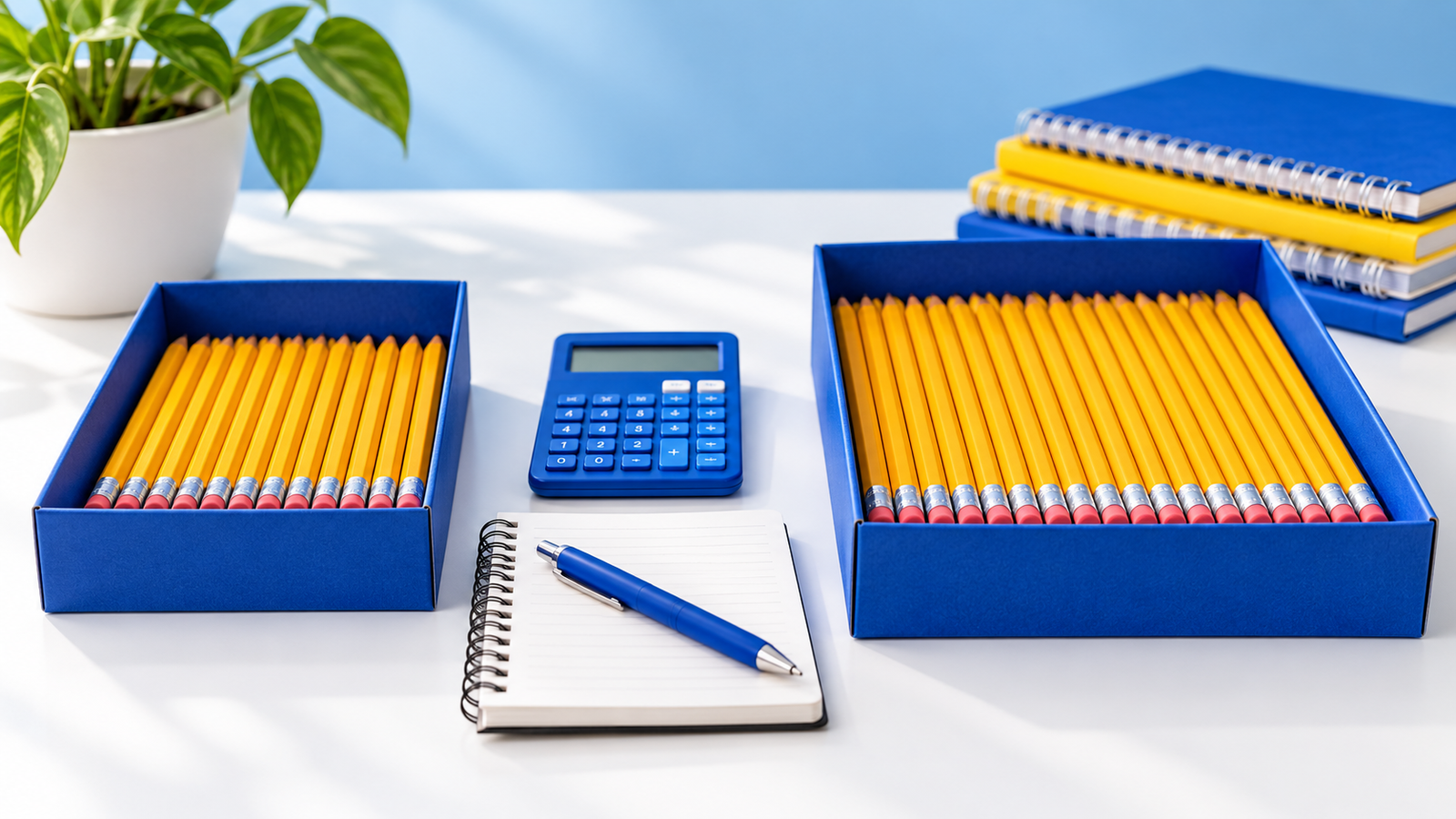
A lower package price does not always mean better value. Comparing pack sizes helps you understand how much you are paying for each pencil, notebook, glue stick, or other school supply.
1. Check that the products are comparable
Before comparing prices, check the product type, size, quality, and specifications. Look for differences such as pencil grade, notebook sheet count, marker type, or glue quantity.
A pack of small glue sticks and a pack of large glue sticks cannot be compared fairly by counting the sticks alone.
2. Find the total quantity in each pack
Read the description carefully. Check whether the stated quantity refers to individual items, packs, or cases.
For example, a listing for six boxes containing 12 pencils each provides 72 pencils in total. Confirm that all six boxes are included in the advertised price.
3. Calculate the price per unit
Use this calculation:
Price per unit = package price ÷ number of usable units
The following example uses hypothetical prices:
- Pack A: 12 pencils for $3.00 = $0.25 per pencil.
- Pack B: 24 pencils for $4.80 = $0.20 per pencil.
Pack B has a lower price per pencil, but it requires a higher payment upfront.
4. Choose a suitable comparison unit
The best unit depends on the product:
- Pencils and pens: price per individual item of equivalent type.
- Paper: price per sheet of the same size and specification.
- Notebooks: compare size, ruling, binding, and sheet count as well as price per notebook.
- Glue: price per gram or ounce for the same type of glue.
- Markers: compare marker count, tip type, and the colors included.
Use the same measurement unit for both products. Check whether a notebook listing counts sheets or pages, because one sheet can have two usable pages.
5. Calculate how many packs you need
Divide your required quantity by the number of items in each pack, then round up to the next whole pack.
For example, if you need 30 pencils:
- With 12-pencil packs, you need three packs and receive 36 pencils.
- With 24-pencil packs, you need two packs and receive 48 pencils.
Using the hypothetical prices above, three smaller packs cost $9.00, while two larger packs cost $9.60. The smaller packs cover your needs for less money, even though their unit price is higher.
6. Include delivery and discounts
Review the final checkout total, including delivery charges, applicable taxes, and eligible discounts. Check minimum order requirements and whether a discount applies to every pack.
For a single-product order, you can divide the final total by the number of items received to find the delivered cost per item. For mixed orders, compare the whole basket total because delivery charges may cover several products.
7. Consider whether extras will be useful
A larger pack may suit a classroom or several children sharing supplies. For a small shopping list, extra items may use money and storage space without providing an immediate benefit.
Check that assorted packs contain the types and colors you need. A low price per item is less useful if some items do not meet your requirements.
8. Record the details before buying
For each option, note the product specifications, pack quantity, packs required, total cost, and number of items left over. This makes it easier to choose an option that fits both your needs and your budget.
Plan quantities first
Use our Supply List Builder to organize the items you need. Teachers can also use our Classroom Estimator to support quantity planning. Confirm actual pack sizes and retailer prices before purchasing.